
Looking for something? Search Here »


Posts Tagged ‘breed’

Is Stress Actually a GOOD Thing For Pets?

26th May 2019

In an era where pets are treated with antidepressants and sedatives because they aren’t coping with our
modern lifestyle.Feed them until they drop” training methods are resulting in pet obesity AND where providing firm and consistent pet discipline gets you labelled as “cruel”

Should we actually be better allowing some stress in our pet’s lives? New research is giving results that are NOT as expected.


2 KINDS OF STRESS:

  1. Acute Stress -This is the short, sharp stress that you feel when a truck is bearing down on you – your blood flow increases, adrenaline runs high and you feel stronger, think faster and move faster. New research shows that most animals actually learn better under acute stress!
    Short periods of acute stress can also increase intelligence and can even be good for the immune system! This “safe stress” can build resilience and also reduce the effect of bad or chronic stress.
    The best example is a bitch managing a litter of pups. They do wrong – they get a sharp nip and then all is forgiven. Then she licks them as soon as they “do good”. The pups learn fast.
    Acute stress can also be exciting and thrilling, in short bursts. You see this immediately after a cat
    pounces, or a dog gets excited after completing a difficult training task.
  2. Chronic Stress – This can be lower level ongoing stress, or just lots of acute stresses so close together that they add up too much. This can include the daily grind of separation anxiety, or a pet parent who genuinely doesn’t like the pet (and pets can tell), or variations in owner behaviour so that the pet genuinely
    doesn’t know when it’s “done good” or “done bad” (for example, permitting or even encouraging some behaviours some of the time and punishing them for others).
    So it’s chronic stress we want to avoid. Providing short periods of acute stress can be useful though.

SECOND: Understand punishment! Just like stress, there is good punishment and bad punishment.

1. Positive punishment refers to the fact that when a dog does something which we don’t want him to do we apply something the dog doesn’t like, which could be a slap or a loud reprimand.


2. Negative punishment involves taking something that the individual wants away from him. A human example would be if the child acts out the dinner table he doesn’t get dessert when everybody else does.


Here’s the problem most “positive reinforcement” advocates associate feedback associated with acute stress as bad for the animal. They point to studies that associated short term low level acute stress responses (e.g. lip licking) as “bad”. But is it?


HERE’S THE REAL PROBLEM: NOT ALL DOGS ARE THE SAME!
Some dogs just want to please, you can just look at them and they will virtually train themselves.
Others are headstrong and unwilling, and they are usually the “obedience school dropouts” that nobody counts when they publish the studies about food rewards and the traditional view of “positive reinforcement”.
But our job is to keep dogs under control (a legal requirement) and safe! NO dog can afford to fail basic obedience (even if that means “stop attacking the postman”).


HERE’S THE SOLUTION:
1. Punishment does not include violence.

2. Recognise that all dogs are different and need tailored training methods with different mixes of food reward, motivation reward (e.g play) and constant verbal feedback (positive and negative)

3. Recognise that the short term stress of positive verbal feedback may be conducive to learning, but not often.


“Designer Dogs” Are Actually The Breeds We Have Today!

26th May 2019

Contrary to popular belief, it was Victorian Era dog breeders who developed most of the “Designer Dogs” we have today. Almost every dog breed we know today was a “Crossbred”, but Breed Associations attitudes were different in those days.


A recent article from Emeritus Professor Michael Worboys traces the origins of most modern breeds.
Modern Irish Wolfhounds are actually Scottish Deerhounds crossed with Great Danes, given that the real Irish Wolfhounds were extinct. The result was then crossed with Tibetan Mastiffs and Boxers to give the “mongrel” that is now recognised as the “purebred” dog we know today.Golden Retrievers are actually an inbreeding of the original mix of yellow coloured Retriever with a Tweed Water Spaniel.


Why is this so possible? Research suggests that creating such massive changes in dog body shape in
such a short time may be a result of the fact that dogs have a relatively small number of genes

compared to some other species – around 19,000 protein coding genes compared with around
47,000 in humans (and cats have around 20,000). That, plus a small generation interval, means that dogs can undergo selective breeding rapidly to produce new body shapes and temperaments.

With the number of dog breeds rising from 27 in 1877, to 80 breeds in 1900, and 339 breeds today, perhaps it’s only a matter of time before Cavoodles become a breed? If so, the Pet Industry had better be ready to provide what their doggy clients need! (more…)

Have Humans Done Some Working Dogs A Disservice?

7th Sep 2018

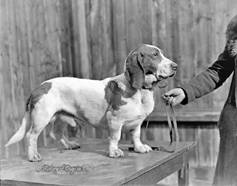
Basset circa 1940’s


Now see the progression of the breed over the last 80 years….

UK Basset 2008


UK Basset 2018 – after nearly 10 years of activism on breed extremes


Bassets were developed as scent dogs and hunters – able to run all day and follow a scent for miles.

How many Australian Bassets would meet these criteria?

SOURCE: adapted, from Pedigree Dogs Exposed. See http://pedigreedogsexposed.blogspot.com

© 2026 Pets Australia Pty Ltd